
Bhringraj for Hair: Benefits, Uses, Side Effects & How to Use the King of Hair
| Estimated Reading Time: 24 minutes |
Okay, real talk if you've spent any time down the Ayurvedic hair-care rabbit hole, you've definitely run into this name: Bhringraj. And no, it's not just another herb with a hard-to-pronounce name that bloggers love throwing around. This one actually earns the hype.
Table of Content: |
Ayurveda literally calls it "Keshraj" — the king of hair. Not "a nice herb for hair." The king. That's a pretty bold title for a plant, so let's find out if it's deserved.

Wait, What Even Is Bhringraj?
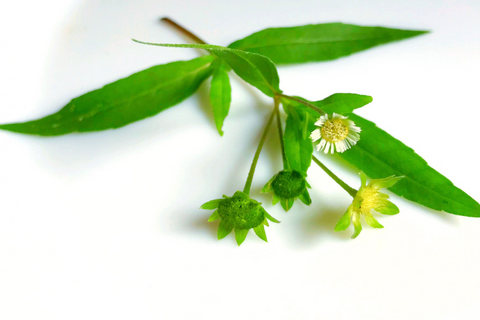
Picture a plant from the sunflower family, except instead of big cheerful sunflowers, you get small white daisy-like blooms. In English, it's actually called false daisy. Botanically, it goes by Eclipta Alba, and you'll find it growing wild and happy in damp, marshy patches across India, China, Nepal, and Brazil.
Here's the fun part: the leaves get crushed up and blended into a carrier oil, usually sesame or coconut and that's how you get Bhringraj oil, the stuff everyone's actually applying to their scalp. The same crushed leaves also make their way into henna hair masks, hair powders, and even juices and capsules for internal use.
Basically, this one plant is doing a lot of multitasking.
A Quick Note on the Science vs. the Tradition
Worth being upfront about this: most of Bhringraj's reputation comes from centuries of Ayurvedic use, not stacks of human clinical trials. Modern research does exist, but it's still catching up a lot of the studies so far have been done on animals (mostly mice and rats) rather than large-scale human trials. That doesn't mean the benefits aren't real; traditional medicine systems often identify effective ingredients long before science catches up to explain why they work. It just means we should treat some of these claims as "promising and traditionally trusted" rather than "clinically proven beyond doubt."
What's Actually Inside Bhringraj? The Chemical Actives
This is the part most articles skip, but it's the whole reason Bhringraj works and not just folklore dressed up as skincare.
The plant's real "muscle" comes from a group of compounds called coumestans, and the headline name here is wedelolactone, along with its close cousins demethylwedelolactone and demethylwedelolactone-7-glucoside. These are the compounds researchers keep circling back to whenever they try to explain Bhringraj's anti-inflammatory, antioxidant, and follicle-stimulating effects. Depending on the extraction method, wedelolactone content in the raw herb has been measured anywhere from roughly 0.2% to 0.7%, which is why "how the powder or oil was processed" ends up mattering as much as the plant itself.
Beyond wedelolactone, the plant's chemical profile includes:
-
Ecliptine — an alkaloid that's one of the oldest identified "active" markers in the plant, tied to its traditional use as a liver and scalp tonic.
-
Flavonoids like luteolin and apigenin — antioxidants that help mop up free radicals on the scalp and are also being studied for antiviral activity.
-
Triterpenoid saponins and β-amyrin — compounds linked to the plant's mild cleansing and anti-microbial behaviour.
-
Phytosterols (like β-sitosterol and stigmasterol) — plant-based compounds structurally similar to cholesterol, thought to support scalp and skin barrier health.
-
Trace alkaloids such as verazine and ecliptalbine, found mostly in methanolic extracts, which are more relevant to Bhringraj's other traditional uses (liver support, wound healing) than to hair specifically.
In lab studies, wedelolactone has shown an ability to bind to receptors involved in hair-follicle signalling (things like the Wnt/β-catenin pathway and VEGF, which control how long a follicle stays in its active growth phase). That's a promising mechanism on paper, but it's worth remembering this is mostly cell-culture and animal-model evidence, not proof of exactly how much a scalp massage with Bhringraj oil delivers to your follicles in real life.
Bhringraj vs. Chemical Actives: What Does the Research Actually Say?
Naturally, the question everyone eventually asks is: does Bhringraj actually hold up against the pharmaceutical gold standard, minoxidil?
Here's the honest picture:
-
Animal studies have looked genuinely promising. In a widely cited 2008 study on male albino rats (published in Archives of Dermatological Research), a petroleum ether extract of Bhringraj leaves was compared directly against 2% minoxidil solution. The Bhringraj-treated group showed faster hair growth initiation, a longer active (anagen) growth phase, and a higher hair follicle count than the minoxidil group over the 30-day trial.
-
A separate 2009 study (Journal of Ethnopharmacology) using a methanolic extract found similar results. Bhringraj-treated skin regenerated hair faster than minoxidil-treated skin in the same experiment, with visibly more follicles entering the growth phase.
-
Cell-level research backs up the mechanism. Later lab work using human dermal papilla cells (the cells at the base of each follicle that control growth) found that Bhringraj extract measurably increased cell proliferation, lending some support to the idea that it's doing more than just "coating" the hair.
So why isn't Bhringraj sold in a pharmacy next to minoxidil? Because all of this evidence is preclinical, done in rats, mice, or petri dishes, not in large controlled human trials. Minoxidil, by contrast, has decades of human clinical data and FDA approval behind it, which is a very different (and much higher) evidence bar. A small human study (around 50 participants) and a handful of older observational reports out of China have hinted at real-world benefit, but nothing close to the scale of minoxidil's trial record exists yet.
The fair takeaway: Bhringraj looks genuinely competitive with minoxidil in animal models, and its mechanism of action is biologically plausible but it hasn't been tested against minoxidil in a rigorous human head-to-head trial. Think of it less as "proven better than the pharmacy option" and more as "a scientifically interesting natural candidate that traditional medicine got to first."
So Why Is Everyone Obsessed With It for Hair?
Ayurvedic texts have been singing praises for Bhringraj for centuries under names like Bhring, Keshranjan, Angarak, and Bhringaar different names, same royal reputation. Most of the modern research so far has been on animals rather than humans, but the early findings are genuinely promising: antioxidant, anti-inflammatory, and packed with nutrients.
Here's what it's actually doing for your hair, feature by feature:
1. It Wakes Up Lazy Hair Follicles
Bhringraj oil seems to boost the number of active hair follicles on your scalp which basically means the door is open for thicker, fuller-looking hair over time. It does this through vasodilation ( a fancy term for "widening your blood vessels"), which improves blood flow to the scalp. More blood flow = more nutrients reaching your hair roots = happier, stronger strands.
2. It Fights Back Against Hair Fall
More active follicles naturally means fewer strands falling out. Add to that Bhringraj's decent Vitamin E content, which helps your scalp fend off free radicals (the tiny troublemakers behind cell damage), and you've got a herb that's quietly working overtime to keep your hair where it belongs on your head.
3. It Might Slow Down Greying
This one's interesting. Similar to henna, crushed Bhringraj leaves release a natural dark pigment, which is partly why it's used to reduce that greying look. On top of that, its nutrient profile may help slow the pigment loss that causes grey hair in the first place. That's exactly why you'll often find it paired with henna in DIY hair masks.
4. Dandruff, Meet Your Match
An overnight scalp massage with warm Bhringraj oil is basically Ayurveda's version of a dandruff SOS button. Dandruff usually shows up thanks to a dry, irritated scalp and Bhringraj's antimicrobial properties help calm that irritation while its oil penetrates deep into the follicles (people say it has unusually high "specific gravity," which just means it soaks in well).
5. It Soothes an Irritated, Infection-Prone Scalp
Thanks to its antibacterial nature, Bhringraj is often used for scalp issues like folliculitis and even fungal irritations like ringworm. Regular use is said to calm inflammation, reduce tenderness, and take the itch out of an unhappy scalp.
If you want the fuller science-meets-tradition breakdown on why oiling works this well for your scalp type in the first place, our complete guide on choosing the right hair oil for your hair and scalp is a great place to start.
6. It May Help With Thinning Edges and Receding Hairlines
While most Bhringraj research focuses on overall hair growth, anecdotal use especially in South Asian households leans heavily on it for thinning hairlines and patchy edges, often caused by tension, stress, or postpartum hair loss. The theory is simple: better blood flow + reduced follicle inflammation = a better shot at regrowth in areas that have gone dormant rather than scarred. It's not a miracle fix for hairlines affected by long-term traction alopecia, but for stress- or hormone-related thinning, it's one of the more commonly reached-for remedies.

7. It Adds Shine and Softness You Can Actually See
Beyond the internal follicle-level stuff, Bhringraj oil also works as a straightforward conditioning agent. Regular use tends to leave hair visibly glossier and softer to the touch — partly because it helps seal in moisture, and partly because it smooths down the hair cuticle. This is the kind of benefit that shows up almost immediately, unlike growth or greying, which take weeks to months to notice.
8. There's Early Interest in It as a DHT Blocker
One of the more interesting (and less talked-about) findings is that methanolic extracts of Bhringraj have shown some ability to inhibit 5-alpha-reductase in lab studies — the same enzyme that converts testosterone into DHT, the hormone most linked to pattern hair loss. This is still early, mechanism-level research rather than proof it works like finasteride, but it's a big part of why some people reach for Bhringraj specifically for hormonal or genetic thinning, not just stress-related hair fall.
Bhringraj vs. Brahmi: Don't Mix Up These Two
If you've spent any time in an Ayurvedic aisle, you've probably seen Bhringraj and Brahmi sitting right next to each other, sometimes even blended into the same bottle. They get lumped together a lot, but they're actually not doing the same job.
Brahmi (Bacopa monnieri) is a different plant entirely a small succulent that grows along riverbanks and in marshy patches across India, and it's been part of Ayurvedic memory-and-brain tonics for roughly 3,000 years. For hair, its strength is conditioning: it's loaded with antioxidants that hydrate and add shine, which is why it shows up so often in hair masks and treatment packs rather than daily oiling routines.
Here's the simplest way to think about the split: Bhringraj works at the root, Brahmi works along the length. Bhringraj is the one people reach for when they want thicker regrowth and less shedding, since its job is stimulating the follicle itself so it's usually massaged straight into the scalp. Brahmi is better suited to the mid-lengths and ends, where its moisture-sealing, cuticle-smoothing effect actually shows up as softer, glossier hair.
They do overlap in a few ways, though. Both contain vitamin C and E, both have anti-inflammatory and antifungal properties, and both are dosed similarly for topical use. So it's not wrong to use them together a lot of traditional formulations do exactly that, applying Bhringraj to the scalp and letting a Brahmi-based mask handle the lengths. If you had to pick just one for hair fall and regrowth, though, Bhringraj is the one with the stronger case.
Hold On – Bhringraj Does More Than Just Hair
This is where it gets genuinely impressive. Ayurveda associates Bhringraj with calming pitta dosha (think: fire/heat imbalances in the body), and its benefits stretch well past your scalp.
-
Better sleep & less stress — Bhringraj is naturally rich in magnesium, a mineral basically famous for helping you relax. A gentle oil massage can do wonders before bedtime.
-
Headache relief — Especially for stress-related headaches. Some people dab the oil directly on their forehead; others use it as a nasal oil for a calming effect.
-
Liver support — Ayurvedic tradition has long used Bhringraj juice as a liver tonic, and some newer studies hint that it may support liver cell regeneration.
-
Wound healing — Bhringraj has traditionally been applied topically to minor cuts and insect bites, thanks to its antimicrobial and mild astringent properties. It's not a replacement for proper wound care, but it's part of why village and home-remedy traditions reach for it beyond just hair and skin.
-
Digestive help — Ayurveda calls it a "Jatharagni Deepaka," which is basically a fancy way of saying it fires up your digestion. It's traditionally used for gastric issues, nausea, and even ulcers.
-
Calmer skin — Its anti-inflammatory, antimicrobial nature can help with irritated skin, including conditions like eczema or mild acne.
-
Brain & memory support — Early animal studies (paired with ashwagandha) showed some promising effects on brain cell health. Human research is still catching up, but it's an exciting space to watch.
About the Herb Itself: Sourcing, Spotting Good vs. Bad Bhringraj, Cost, and Growing Your Own
Since Bhringraj is a raw herb before it's ever an "oil" or a "powder," it's worth understanding the plant itself because quality varies a lot more than people expect.

Where It's Actually Grown
Bhringraj grows wild in damp, marshy, waterlogged land — roadside ditches, paddy field edges, riverbanks, and low-lying wastelands. In India, it's commonly found across Rajasthan (Sojat is a well-known sourcing hub for herb powders generally), Uttar Pradesh, Bihar, West Bengal, and much of South India, and it also grows across China, Nepal, Thailand, and Brazil. It's considered a 3-month crop when cultivated commercially, usually planted after the rains and harvested at early flowering, which is when its active-compound content is thought to peak.
How to Tell Good Bhringraj From Bad Bhringraj
Because it's a wild-harvested herb sold mostly as a powder, adulteration and inconsistent quality are common complaints. A few practical checks:
-
Colour — Genuine Bhringraj powder is dark green to brownish-black. If it looks pale, dusty, or greyish, it's likely old stock, poorly dried, or bulked up with fillers.
-
Smell — It should have a distinct earthy, slightly bitter, "green" aroma. No smell at all, or a musty/stale smell, is a red flag.
-
Texture — Pure leaf powder is fine but not perfectly uniform like a lab-made cosmetic powder. Excessive clumping usually points to moisture damage or added anti-caking agents.
-
Ingredient label — For powders and extracts, the label should read only "Bhringraj (Eclipta alba/prostrata)" with no maltodextrin, starch, or "herbal blend" language hiding filler content.
-
Extract ratio, if buying a standardised extract — Ratios like 10:1 are common and credible; anything claiming 50:1 or higher without a Certificate of Analysis is worth being skeptical of.
-
Certificates of Analysis (CoA) — Reputable sellers, especially for oral use, will provide (or share on request) lab testing for heavy metals, microbial contamination, and solvent residue.
-
Origin labelling — Indian-grown Bhringraj is generally considered the gold standard because of the traditional processing knowledge behind it, but that alone isn't a guarantee of purity — pair it with the checks above rather than relying on "Made in India" as proof.
What Does It Actually Cost?
Bhringraj is genuinely inexpensive as herbs go, since it grows abundantly and isn't difficult to cultivate. As a rough sense of Indian retail pricing:
-
Loose leaf powder typically runs somewhere around ₹300–450 for a 100g pack, dropping to roughly ₹600–1,000/kg for retail-sized bulk, and further down toward ₹400–700/kg (or less) at wholesale bulk quantities of 5–25kg+.
-
Standardised extract powders (10:1 or higher) cost noticeably more than raw leaf powder because of the processing involved.
-
Ready-made Bhringraj hair oils vary widely in price depending on the brand and what else is blended in (amla, brahmi, curry leaf, etc.), so the oil itself isn't a reliable indicator of how much actual Bhringraj is inside, check the ingredient list for its position (closer to the top = more of it).
Can You Grow Bhringraj at Home?
Yes, and it's actually one of the easier medicinal herbs to keep alive:
-
Light — It prefers a spot with mild morning sun or partial shade; harsh, all-day direct sun isn't ideal.
-
Soil — Loamy, well-draining soil that's kept evenly moist (not soggy, not dried out) mimics its natural marshy habitat best.
-
Watering — Regular watering is key since it's naturally a moisture-loving plant letting the soil dry out completely will stress it.

-
Propagation — You can start it from seed (soak/sow in a well-draining mix and keep consistently moist until germination) or, more easily, from a stem cutting snip a healthy stem, strip the lower leaves, and root it in water or moist soil.
-
Growth habit — It's a fast, trailing, almost weed-like grower, reaching about 2–3 feet, and does well in a pot, hanging basket, or a damp corner of a garden bed.
-
Harvesting — You can start snipping leaves once the plant is established (usually within a couple of months), and regular pruning actually encourages bushier, fuller growth.
-
Pests — It's relatively low-maintenance; occasional pest issues can usually be handled with neem oil rather than harsh pesticides.
If you've got a balcony, a damp shady corner, or even just a consistently watered pot, homegrown Bhringraj is a realistic option and it means you control exactly what goes into your leaves, with zero adulteration risk.
What About the Carrier Oil? A Quick Word on Sesame
Bhringraj rarely works alone it's almost always infused into a base oil, and sesame oil is one of the most traditional (and honestly under-discussed) choices for that base, alongside coconut oil.
Sesame oil brings its own set of actives to the mix: sesamin and sesamol, two antioxidants that help protect hair from oxidative stress, plus a fatty acid profile that forms a light protective layer around each strand to help lock in moisture. On its own, sesame oil is traditionally used to slow premature greying, calm an overheated scalp in summer, and act as a mild natural barrier against sun and pollution exposure benefits that complement rather than duplicate what Bhringraj is doing.
One distinction worth knowing if you're buying rather than DIY-ing: black sesame oil (pressed from unhulled seeds) is considered richer in minerals and antioxidants, making it the better pick if you're dealing with hair loss, thinning, or early greying. White sesame oil is lighter and more refined, so it suits regular maintenance better than active repair. Either way, cold- or wood-pressed is what you want refined sesame oil loses most of the compounds that make it worth using in the first place.
So if you're ever choosing between a coconut-oil-based Bhringraj blend and a sesame-oil-based one, it's less about which is "better" and more about what your hair needs sesame leans toward protection and anti-greying, coconut leans toward deeper moisture.
How Do You Actually Use This Stuff?
Good news: Bhringraj is ridiculously versatile. Here are the tried-and-tested favorites:
The Overnight Oil Ritual: Warm up some Bhringraj oil, massage it into your scalp the night before your hair wash, and let it work its magic while you sleep. Over time, this simple habit can lead to thicker, shinier hair and it's especially soothing if your scalp tends to get dry or itchy.
Getting the Most Out of a Champi Session: A few small habits make a real difference to how much benefit you actually get from an oiling session:
-
Warm the oil slightly before applying it. Warmth opens up the follicles a bit and helps the oil penetrate rather than just sit on the surface.
-
Detangle your hair before oiling, not after. Post-massage, hair is more fragile, so combing it while it's oiled and matted just pulls out more strands than necessary.
-
If you have one, use a nozzle applicator to get the oil straight to the roots. Pouring it on with your fingers tends to load up the strands near the roots while barely reaching the scalp which is where it actually needs to go.
-
Massage with your fingertips for a solid 10 minutes, and if you can, spend a minute or two with your head tipped upside down while massaging it briefly increases blood flow to the scalp.
-
Leave the oil on for 2–3 hours rather than overnight if you're worried about your scalp getting too oily or dandruff-prone; that window is usually enough for the oil to do its work without inviting fungal buildup.
-
When washing it out, focus the shampoo on your scalp rather than scrubbing the lengths the suds rinsing down are usually enough to clean the ends without stripping all the oil you just massaged in.

Amla + Bhringraj Hair Mask: Amla brings in a solid dose of Vitamin C, and together with Bhringraj, it makes for a gentle, natural cleansing combo. Blend one whole amla with a spoon of bhringraj powder and a little water, apply it 30–60 minutes before your wash, and rinse.
Bhringraj + Henna for Natural Colour: If you're trying to ditch ammonia-loaded hair dyes, this combo is worth knowing. Mix henna powder with bhringraj powder, amla powder, brahmi powder, and a splash of beetroot juice. Apply root to tip, let it sit for 2–3 hours, then rinse and follow up with a gentle herbal shampoo.
Bhringraj Anti-Dandruff Mask: Mix two teaspoons of Bhringraj oil with three tablespoons of yoghurt, a few drops of tea tree oil, and a small amount of grated ginger. Apply to the scalp, leave for 20–30 minutes, then wash out with an anti-dandruff shampoo. Repeat weekly until symptoms clear, then drop to monthly for maintenance.
Bhringraj Conditioning Rinse: Simmer two teaspoons of Bhringraj oil with a litre of water, a couple of teaspoons of loose tea leaves, and two tablespoons of vinegar for about 10 minutes. Let it cool, strain out the solids, and use the liquid as a post-shampoo rinse. It's a lighter way to get some of the oil's benefit on days you don't want a full, heavy champi.
Curious about other hair oil routines and post wash tips that pair beautifully with herbs like this? We've got you covered in our guide on hair oil routines, post-wash tips.
And if you'd rather skip the store-bought stuff entirely and whip up your own Ayurvedic oil at home, this one's for you: how to make ayurvedic hair oil at home.
How Long Before You Actually See Results?
This is the question everyone wants answered and nobody likes hearing the real answer: it depends, but expect 8–12 weeks minimum for genuinely noticeable changes in shedding or thickness, and that's with consistent use meaning 2–3 times a week, not "I tried it once and forgot about it." Hair growth cycles are slow by nature, so this isn't a herb (or category of product) that rewards impatience. Shine and softness you might notice within the first week or two; actual follicle-level change takes months, not days.
The Bhringraj Variety Mix-Up: Why "Yellow Bhringraj" Might Not Be Bhringraj at All
Here's something almost nobody mentions when they talk about sourcing Bhringraj, and it's a real quality issue, not just trivia.
Classical Ayurvedic texts describe Bhringraj in three colour-based varieties, based on flower colour:
|
Variety |
Sanskrit Name |
Botanical Reality |
Availability |
|
White |
Shweta Bhringraj |
True Eclipta alba / Eclipta prostrata |
Common — grows wild as a weed in moist areas |
|
Yellow |
Peeta Bhringraj |
Often actually Wedelia chinensis (a related but different plant, sometimes called Wedelia calendulacea) |
Rare, and frequently substituted |
|
Blue |
Neela Bhringraj |
Considered the ripened/mature stage of the white flower, not a truly distinct species |
Rarely seen on its own |
Why this matters: the white-flowered Eclipta alba is the one that's been chemically studied for wedelolactone, ecliptine, and the hair-growth activity covered earlier in this article. The "yellow Bhringraj" sold in some markets and formulations is often a completely different plant, Wedelia chinensis, that historically got folded into the Bhringraj name (it's referenced in classical texts as "Pitta Bhringraja") because it shares a similar look and some overlapping traditional uses. But it isn't the same botanical species, and it hasn't been through anywhere near the same level of phytochemical or hair-growth research as true Eclipta.
What this means for you as a buyer:
-
If a product simply says "Bhringraj" without a botanical name, you can't actually confirm which plant you're getting.
-
Look for the Latin name Eclipta alba or Eclipta prostrata on the label that's the one backed by the research in this article.
-
Be a little skeptical of "rare yellow Bhringraj" marketing, since it's often Wedelia, not a premium version of true Bhringraj rarity here doesn't equal potency.
-
If you're growing your own (see the home-growing section above), the white-flowered variety is the one to plant; it's also the easier one to source as seed or cutting, so this is a case where "common" and "correct" line up nicely.
This is also a good reminder for the "how to identify pure Bhringraj" checklist earlier — colour, smell, and CoAs help you avoid fillers and adulteration, but confirming the actual botanical name is the step that protects you from buying the wrong plant entirely.
A Quick Reality Check: Precautions to Keep in Mind
Natural doesn't automatically mean risk-free, so a little caution goes a long way:
-
Taking Bhringraj orally may cause a cooling/chills sensation in some people who always check dosage with a professional before ingesting it.
-
First time applying the oil or powder? Do a quick patch test on a small area of skin and wait an hour to check for any reaction.

-
If you notice itching, swelling, redness, or irritation stop use immediately and consult a professional.
Also worth knowing: how often you oil matters just as much as what you oil with. If you've ever wondered whether you're overdoing it (or underdoing it) with hair oil depending on the season, check out our seasonal hair oil guide for summer, monsoon, and winter.
Quick FAQs
1. How much Bhringraj should I actually take?
Typically 1–3 grams of powder or 10–20 ml of juice, once or twice a day but this really should be confirmed with a healthcare professional first.
2. Can Bhringraj help with a sore throat?
Yes, a warm water or honey mix with bhringraj powder can be taken orally, and it can also be used as a gargle to ease inflammation.
3. Does Bhringraj affect Vata, Pitta, and Kapha doshas?
It tends to balance Pitta and Kapha (reducing excess mucus and inflammation) while mildly supporting Vata.
4. What Ayurvedic products usually contain Bhringraj?
You'll spot it most often in hair oils, throat-care blends, liver detox formulas, and general rejuvenation tonics.
5. Can I use Bhringraj oil every day?
Yes, for most people daily use is fine, especially at night before a wash day. That said, if you have a naturally oily scalp, 2–3 times a week is usually enough to get the benefits without over-oiling.
6. Is Bhringraj oil safe during pregnancy?
Topical application (massaging into hair/scalp) is generally considered safe, but oral consumption of Bhringraj juice or capsules during pregnancy should only be done under a doctor's or Ayurvedic practitioner's supervision.
7. Can Bhringraj be used on colour-treated hair?
Yes in fact, it's often recommended for colour-treated hair since it conditions without stripping colour, unlike some sulfate-heavy shampoos. Just patch-test first if you've recently used chemical treatments, since the scalp can be more sensitive post-colour.

8. Does Bhringraj work for all hair types?
Broadly yes, but people with very fine or naturally oily hair may want to use a lighter hand or focus application on the scalp rather than the full length, since Bhringraj oil can feel heavy if overused on already-oily strands.
9. Can men use Bhringraj oil too?
Absolutely it's not gendered in any way. It's commonly used for male-pattern thinning and is often blended with other ingredients like rosemary or amla in men's hair-fall oils.
10. Is Bhringraj the same thing everywhere it's sold?
Not quite — you'll see it labelled Eclipta alba or Eclipta prostrata (these refer to the same plant), and regional names like Maka, Karisalankanni, Kayyunni, or Bhangra all point to the same herb. What varies is quality and processing, not the plant itself.
The Bottom Line
Bhringraj has earned its royal title fair and square. Sure, not every claim has heaps of modern clinical research behind it yet, but centuries of Ayurvedic use backed by early scientific findings make a pretty compelling case. Whether you're battling hair fall, dandruff, greying, or you just want a stronger, shinier mane, this humble little daisy-like herb deserves a spot in your hair-care shelf.
If you'd rather not deal with grinding leaves and mixing masks yourself, exploring a ready-made Bhringraj-infused oil is a simple way to get started. And if you're curious about other underrated hair oils worth trying, our piece on Batana oil a hidden gem for thicker, fuller hair is a great next read.
Recommended Products by Blue Nectar:
Bhringraj Hair Fall Control Oil for Healthy Scalp for Men & Women (10 Herbs)
Rosemary Oil for Hair Growth and Hair Fall Control (9 Herbs)
Briganantadi Tea Tree Anti Dandruff Oil for Hair | Clean & Healthy Scalp
Related Articles:
Complete Hair Care Guide: Healthy Hair & Scalp Tips
Common Hair & Scalp Concerns: Complete Care Guide
Complete Guide to Hair Oiling: Benefits & Techniques
Batana Oil for Hair: The Honduran Secret Behind Thicker, Fuller Locks
References:
https://jaims.in/jaims/article/view/5660
https://journals.stmjournals.com/rrjoasyn/article=2025/view=194428/
https://www.academia.edu/96950718/Hair_growth_promoting_activity_of_Eclipta_alba_in_male_albino_rats
https://www.sciencedirect.com/science/article/abs/pii/S0378874109003122
https://ayurveda.com/resources/what-is-pitta-dosha/
https://ayurvaid.com/ayurveda-concepts/digestion-metabolism/types-of-agni/


amazing
Bhringraj benefits are underrated! Great to see this blog highlighting its role in natural hair growth, reducing dandruff, and improving scalp health.
Leave a comment